The first bet I ever regretted is one I won. I was nineteen, stood in the Pontoon at Blundell Park with my collar up against whatever the North Sea had decided we deserved that afternoon, and I had a fiver on Grimsby Town at 5/2 to beat a side chasing promotion, because I had watched us all season and I knew, in the way that only a teenager knows things, that we were better than the table said. We won 1-0. The goal arrived late, off a shin, possibly two shins. On the Monday the shop on Freeman Street counted out my seventeen pounds fifty as though settling a ransom, and I walked home having learned exactly the wrong lesson.
The lesson I took was that I could see things the bookmaker could not. The lesson on offer was that a 5/2 shot wins sometimes, that "sometimes" has a number attached, and that I had never asked what the number was. Unlearning that one afternoon took me years, and a running total I have the tools to compute and the good sense not to.
What saved me, eventually, was the club itself. Supporting Grimsby Town is a statistics course with a turnstile. You pay in, week after week, and the game teaches you by demonstration that hope is not a forecast, that last season's table is not a promise, and that a team can deserve something for ninety minutes and still not get it. Somewhere between one goalless draw and the next, I stopped asking who would win and started asking a quieter question: how often does this sort of thing actually happen? That question has a discipline attached. The discipline is called statistics, and this book is about what happened when I pointed it at the betting market and the betting market flinched.
So here is the contract, up front, where a contract belongs. There are no tips in this book. There is no bet of the day. Nothing in it is sold to you as safe or sure, because no bet is either, and any book that says otherwise is selling you something other than a book. What you get instead is a method, honestly costed, with the losing months shown as prominently as the winning ones. The industry would rather you did not read it. That is not a conspiracy theory; it is a business model, and we will take it apart bolt by bolt.
The idea in one line: a bet is judged by the price you accepted, not by the result that followed; the result arrives too late to be advice.
The result is loud. The price is quiet.
Every part of the betting experience is built to make you stare at results. The results are the fireworks: the last-minute winner, the cash-out screenshot, the mate whose four-fold came in. But results are what happens after the only decision you ever controlled, which is whether the price you were offered was bigger than the chance deserved. That decision is made in silence, before kick-off, with a pencil. Everything in this book flows from taking the pencil seriously.
Let me show you the whole argument with a coin, because a coin is just a very honest football team. Imagine a team whose true chance of winning is exactly 50 per cent, and imagine backing them a hundred times at 4/5. Fifty wins pay 80 pence each: £40 in. Fifty losses cost a pound each: £50 out. You are £10 down per £100 staked, and no amount of shrewdness about the team can rescue you, because you were never wrong about the team. Now run the same hundred bets at 11/10. Fifty wins pay £1.10 each: £55 in, £50 out, £5 up. Same team. Same opinion. The coin never improved; the price did. Betting well is the craft of telling those two situations apart, and almost nothing about watching football teaches it to you.
There is a second way to read those three prices, and it is the way Part I will train your eye to work without being asked. Every fractional price is a probability claim wearing a disguise. At 4/5 you risk five to win four, so the price is claiming the outcome lands five times in every nine, which is 55.6 per cent. Evens claims one time in two: 50 per cent exactly. And 11/10 claims ten times in twenty-one, about 47.6 per cent. Hold those claims up against the coin's true 50 per cent and the sums above stop being arithmetic and start being obvious. At 4/5 you were sold 55.6 per cent of chance and handed 50; at evens the label matched the tin; at 11/10 somebody priced a 50 per cent coin as though it were worse than it is, and that somebody paid for the privilege. Do not worry about doing the conversion in your head yet. The next few chapters build the machinery a piece at a time, and by the end of Part I the disguise will not survive a glance.
Notice what that little sum quietly implies: a good result can follow a bad decision, and does, constantly. My afternoon in the Pontoon was a bad decision that paid out, which is the most expensive kind, because it comes with a lesson attached and the lesson is wrong. In May 2016 the whole country got a version of my afternoon: Leicester City won the Premier League having been priced at 5000/1 the previous summer, a price that makes a probability claim of roughly 0.02 per cent, one chance in five thousand and one. Was that price wrong? Was it the value bet of the century? It is the longshot that launched a thousand bad conclusions, and I am going to make you wait until Chapter 5 for the honest answer, because by then you will own the tools to check it yourself rather than take my word. Taking nobody's word is rather the theme.
The shelf this book wants to sit on
Betting books come in two kinds, and both of them fail you, politely, from different directions.
The first kind is the story shelf. Nate Silver's The Signal and the Noise, Rory Smith's Expected Goals, David Sumpter's Soccermatics: proper books, well written, full of syndicates and geniuses and the romance of the numbers. You finish them entertained and improved as a dinner guest, and then it is Tuesday, there is a coupon in front of you, and the book has gone quiet. Stories do not tell you what to do with a price.
The second kind is the textbook shelf, and I say this with genuine respect, because it is where I did my own reading. Joseph Buchdahl's books have the rigour of a laboratory and roughly the same number of jokes. Stanford Wong and King Yao write sharply about markets priced in a foreign accent, for readers who think in American odds. Andrew Mack will teach you to build real models, in Excel and in R, without much caring that British football and fractional odds exist. James Tippett gives you the expected-goals philosophy and the Brentford romance, and leaves you holding both, wondering what to actually do on Saturday. Method without pulse, or pulse without Britain.
I went looking for the book in the gap: British, fractional odds on the page, a model you genuinely build, straight about the mathematics of losing, and written by someone who has stood in the rain while the theory played out in front of him. I found none. I am careful with that sentence, because you cannot prove a book does not exist; you can only report an honest search. The search came back empty, so I wrote the book instead. Whether it deserves the gap is now your problem rather than mine.
The 2026 twist: the code is free now
There has never been a stranger moment to write this book, and never a better one. For most of my working life, the wall between a punter with ideas and a punter with a model was code. You could understand exactly what a Poisson model was and still be defeated by a semicolon. That wall has now been demolished by machines that will write the code for you while you make the tea. When we build our first match model in Chapter 16, an AI assistant can produce the working program from a plain-English description in less time than it takes to read this paragraph.
Which sounds like the end of the story and is in fact the beginning, because the same machines, asked to do the betting rather than the typing, are a catastrophe. In the most telling test published so far, researchers handed frontier AI models a simulated season of Premier League betting, with data, team news and real odds, and told them to grow a bankroll. Every model tested lost money on average, and several lost all of it. Chapter 24 performs the full post-mortem, and Chapters 25 to 27 build the honest alternative. The doctrine of Part V fits on one line: the machine reads and codes, the statistics decide, the human stakes.
So the scarce skill has moved. It is no longer syntax; you can rent syntax by the minute. The scarce skill is knowing what the numbers mean, which questions to ask, and which confident paragraph to distrust, whether it was written by a pundit, a bookmaker or a machine that read the whole internet and still invents team news. That skill is called statistics, and it is the one thing this book will not let you outsource.
What "responsible" means in a book like this
Most betting books handle responsibility the way a cigarette packet handles health: a paragraph of solemn boilerplate, bolted to the back, in a different voice from everything before it. I think that approach fails because it treats responsibility as a mood, and moods lose to markets every time.
This book treats it as engineering. The evidence, which Chapter 32 walks through properly, points one way: slogans about gambling responsibly do not measurably change behaviour, and structures do. A bankroll ring-fenced before the season starts. Deposit limits set on the operator's own tools. A written record that refuses to flatter you. Self-exclusion machinery for the day it stops being a hobby. Chapter 32 is not an appendix of apologies; it is the same statistics as the rest of the book, pointed at the most important variable you own, and it argues that sensible staking and responsible gambling are the same subject wearing different jackets.
One structural habit starts now, in Chapter 1, and runs through everything: the correct number of bets on a given Saturday is frequently none, and this book will say so more than once. A method that cannot output "no bet" is not a method. It is an appetite with a spreadsheet.
The reader's toolkit
You need three things to read this book properly, and none of them is money.
The first is a spreadsheet or a notebook, because the entire enterprise runs on written records, and Chapter 30 will show you how to audit your own. Memory is not a record. Memory is a press officer: it remembers your wins in high definition, files your losses under bad luck, and issues corrections to nobody.
Start the record today, even though you have no method to record yet, and keep it embarrassingly simple: the date, the match, the price you took, the stake, the result, and one honest sentence about why you struck the bet. The why column is the one that matters most and gets filled in worst. Six months from now the results columns will tell you what happened, but the why column will tell you who you were while it was happening, and no bank statement can do that. If you have bet before, exercise one at the end of this chapter will show you how much editing your memory has already done on your behalf. If you have never bet, better still: you get to open the ledger before the press officer is hired.
The second is a ring-fenced bankroll, decided while you are calm, which means now, in daylight, at Chapter 1, not at 9.40 on a Saturday night. The definition is operational: a sum whose total loss changes nothing about your rent, your bills, your debts or your family. Write the number down. Chapters 28 and 29 will teach you how to stake from it; nothing before then requires you to stake at all.
The third is permanent scepticism, and I mean permanent: of pundits, of prices, of your own memory, and of me. Every formula in this book comes with a worked example you can recompute on a phone calculator, and you should, because the habit of checking is worth more than any single number you will check.
The route from here
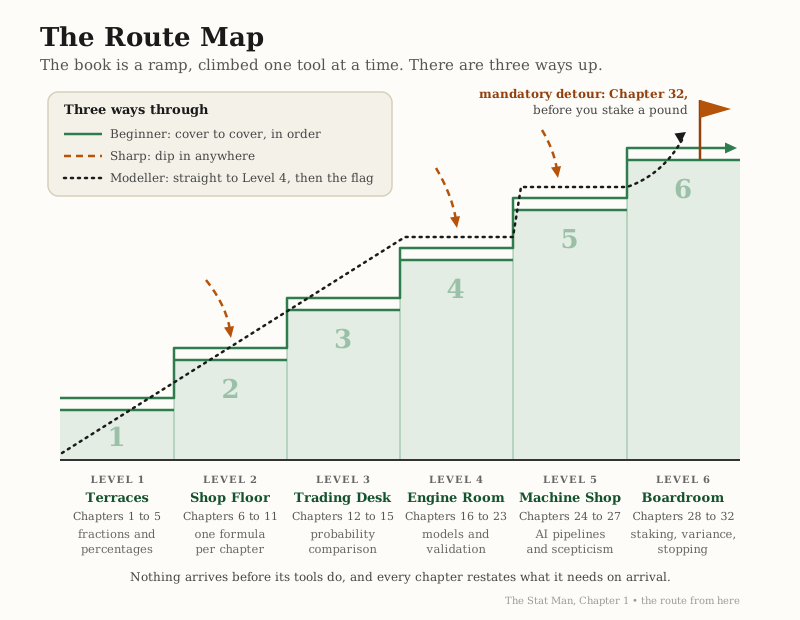
The book is a ramp, and it is climbed one tool at a time. Part I needs nothing beyond fractions and percentages, and by the end of it you will look at 13/8 and see 38.1 per cent, automatically, the way you see a word rather than letters. Part II dismantles the bookmaking machine. Part III teaches you to read the market itself. Part IV builds your model, one chapter per tool, with the machines doing the typing. Part V puts the machines on trial. Part VI, which is really the point of everything, covers staking, surviving and stopping.
There are three ways through. If you are new, read it in order; the ramp is designed so that nothing arrives before its tools do. If you are sharp already, dip in anywhere; every chapter restates what it needs on arrival. And if you are the Sunday-league modeller who bought this for the machinery, go straight to Parts IV and V, but read Chapter 32 before you stake a pound, because I wrote it for you especially.
The Stat Man's takeaway
- Judge every bet by the price you accepted, not the result that followed. Results are loud, late and largely uninformative one at a time. - The same 50 per cent chance loses you £10 per £100 at 4/5 and makes you £5 per £100 at 11/10. You are never betting on the team; you are betting on the price. - The machines will now write your code, and they will lose your money if you let them choose your bets. The scarce skill is statistics, and you are holding a course in it. - Decide your ring-fenced bankroll now, while you are calm, and start a written record. Memory is a press officer, not an accountant. - Nothing here makes betting safe or certain to pay. The correct number of bets on a Saturday is frequently none, and "no bet" is an output this book will teach you to respect.
Try it yourself
Abbreviated answers below; full workings on the companion site.
1. From memory only, list every bet you struck in the last three months, with stakes and results. Then check your account history and compare the two documents. 2. A fair coin pays 4/5 for heads. Is the bet worth taking? What about the same coin at evens, or at 11/10? Work out the average profit or loss per £1 staked for each. 3. A mate says Leicester at 5000/1 proves big outsiders are where the value hides. What single question dismantles the argument? 4. Write down, now, the bankroll figure whose total loss would change nothing about your rent, bills, debts or family.