The language of the price sixty terms, defined
Every term used across The Stat Man, in plain English, with the arithmetic where the arithmetic is the point. Each definition stands on its own and points at the chapter that works it through.
A
- Accumulator (acca)
- A single bet combining two or more selections, all of which must win for it to pay out. The prices multiply, and so, less visibly, does the margin in each leg: a four-leg acca at a modest 8 per cent overround per leg compounds to a little over a quarter of your stake (26.50 per cent) in aggregate tax before a ball is kicked. See Chapter 10.
- Arbitrage
- Betting all outcomes of an event across different bookmakers at prices whose combined booksum falls below 100 per cent, so the result is a small profit whichever outcome occurs. It demands speed and capital spread across accounts that will eventually notice and restrict you, for margins of only 1 to 3 per cent before costs. See Chapter 14.
- Asian handicap
- A market that removes the draw from football by giving one side a head start or deficit measured in goals. A half-line (such as −0.5) settles as an ordinary win-or-lose bet with no push available; whole and quarter lines can push, returning stake on a drawn handicap result. See Chapter 16.
B
- Back bet
- The ordinary side of a bet: you stake money on an outcome happening, and win your stake back plus profit if it does. Every back bet is somebody else's lay. See Chapter 9's "both sides of the counter."
- Bet builder / same-game multi
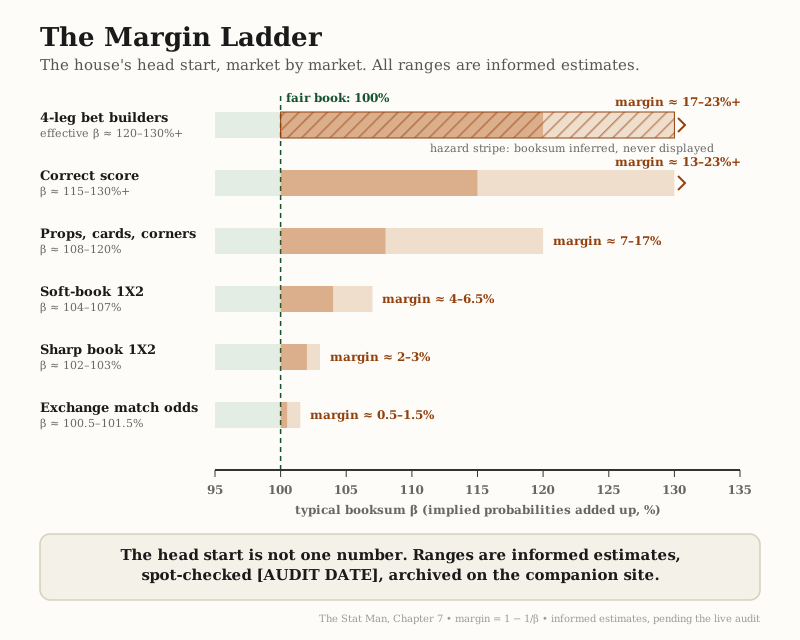
- A bookmaker's combination of several selections from one match, priced not by multiplying independent odds but by an in-house correlation model you cannot inspect. Since same-match legs are rarely independent, and each already sits on a fatter-margined market, effective margins on four-leg builders are commonly measured at 20 to 30 per cent and beyond. See Chapter 10.
- BOG (Best Odds Guaranteed)
- A racing concession promising that if you take a price in the morning and the starting price returned at the off is bigger, you are paid at the bigger number instead. The one clause in the small print with positive expected value by construction. See Chapter 11.
- Book percentage / booksum (β)
- The sum of the implied probabilities of every outcome in a market, expressed as a percentage. A fair book sums to exactly 100 per cent; a bookmaker's sums higher, and the excess is the house's head start. Worked example: fractional prices of 4/6, 14/5 and 9/2 convert to implied probabilities of 60.00, 26.32 and 18.18 per cent, summing to a booksum of 104.50 per cent. See Chapter 7.
C
- Cash out
- An option to settle a bet before the event finishes, at a price the operator sets rather than the market. The offer carries a further margin on top of the original bet's own; a fair value is roughly your win probability multiplied by the potential return, and the operator's offer sits below that on average. See Chapter 11.
- Closing line
- The final price available in a market at the moment it shuts, generally kick-off. Because every scrap of available information has been folded into it by then, the closing line, margin stripped out, is treated throughout this book as the best public estimate of a fair probability. Introduced in Chapter 6; used as the value benchmark in Chapter 12.
- CLV (closing line value)
- The percentage by which the price you took beats the fair, de-vigged closing price for the same outcome. Formula: CLV = (odds taken / fair closing odds) − 1. Worked example: taking 12/5 (decimal 3.40) about a result whose fair closing price is 3.28 gives CLV = 3.40/3.28 − 1 = +3.7 per cent. A far lower-variance signal of skill than a raw win/lose record. See Chapter 30.
- Commission
- The exchange's method of taking its cut: a percentage charged on net winnings within a market, rather than a margin baked into every price. Lose the market and you pay nothing; win and the operator takes its slice, typically in the low single digits. See Chapter 9.
- Correct score
- A market betting on the exact final scoreline, read directly off a Poisson correct-score matrix, a single cell at a time, once the same four inputs used for every other market on the board have been multiplied out. See Chapter 16.
- Courtsiding
- Transmitting live match events from inside a stadium, ahead of the broadcast delay ordinary viewers watch through, to bet or inform others' betting before the television picture catches up. Legal in the UK, but operators treat it as a bannable offence. See Chapter 9.
D
- Dead heat
- Two or more selections finishing tied, with no outright winner. Settlement divides the stake by the number of dead-heaters and settles the surviving fraction at full odds: £10 at 4/1 in a two-way dead heat becomes £5 at 4/1, returning £25. Football punters meet the same rule in top-goalscorer markets. See Chapter 11.
- Double chance
- A bet covering two of three mutually exclusive match outcomes (home-or-draw, draw-or-away, home-or-away), priced by simple addition of the component probabilities. "Home or draw" at a 55 per cent home chance and a 25 per cent draw chance is 80 per cent, no more complicated than that. See Chapter 3.
- Drift
- A price lengthening over time, the opposite of a steamer. Mild evidence against a selection, never in itself a reason to bet: an early wobble on thin limits is not the same signal as a move on rising limits close to kick-off. See Chapter 14.
E
- Each-way
- Two bets in one: a win portion and a place portion, each staked at the amount named. The place half pays a fraction of the win odds (commonly 1/4 or 1/5) if the selection finishes within a specified number of places, a definition that changes with field size and race type. See Chapter 11.
- Edge
- The gap between your own honestly formed probability for an outcome and the probability the market's price implies, in your favour. Necessary before a bet is worth considering, never sufficient alone, since a single bet can lose even when the edge is real. See Chapter 4.
- Elo rating
- A single number per team, updated after every result by comparing what happened to what the rating predicted and nudging both numbers towards the surprise. Expected score: E_H = 1 / (1 + 10^(−(R_H + HA − R_A)/400)), with HA a fixed home bonus. A 200-point gap (1650 plays 1550, home advantage included) gives the home side a 76.0 per cent expected score. See Chapter 18.
- Exchange
- A marketplace where punters bet against each other rather than against a bookmaker, matching backers with layers. The operator earns commission on net winnings rather than a margin on the price, which is why liquid exchange markets carry booksums only a little above 100 per cent. See Chapter 9.
- Expected goals (xG)
- The probability, between 0 and 1, that a given shot results in a goal, estimated from thousands of historically similar shots. A team's match xG is the sum of its shots' values: eight shots worth 0.03, 0.05, 0.02, 0.09, 0.34, 0.04, 0.76 and 0.11 sum to a match xG of 1.44. It describes chances created, not goals actually scored. See Chapter 19.
- Expected value (EV)
- What a bet returns on average, per pound staked, if it could be struck over and over. Formula, for fractional price a/b and probability p: EV per £1 staked = p × (a/b) − (1 − p). Worked example: price 13/8, probability 40 per cent: EV = 0.40 × 1.625 − 0.60 = +0.05, five pence per pound staked. See Chapter 4.
- Expert Fee
- Betfair's charge on the largest, most consistent exchange winners: 0 per cent, rising to 20 per cent then 40 per cent at £25,000 and £100,000 of rolling 52-week gross profits (from January 2025). Evidence that an exchange, indifferent to who wins a market, is not indifferent to a customer who keeps winning. See Chapter 9.
- Extra places
- A promotional widening of an each-way bet's place terms beyond the standard number, common on large-field handicaps. Improves the place-return odds without altering the win side of the bet. See Chapter 11.
F
- Favourite-longshot bias
- The tendency for short-priced favourites to be under-bet relative to their true winning chance and long-priced outsiders over-bet relative to theirs, first documented by the psychologist Richard Griffith in 1949 using American horse racing data. Not universal: Hong Kong racing shows it weakly or not at all. See Chapter 5.
- Fractional odds
- The default price format in this book: a/b, meaning a stake of £b returns £a profit if the bet wins, plus the stake back. 5/2 promises £5 profit for every £2 staked. Converts to an implied probability of b/(a+b). See Chapter 2.
G
- Grand / monkey / pony / ton
- Terrace slang for cash sums: a pony is £25, a monkey is £500, a ton is £100, a score is £20, a grand is £1,000. The claim that the animal terms trace to old Indian rupee notes brought home by soldiers is folklore, repeated everywhere and verified nowhere. See Chapter 2.
H
- Hedging
- Placing a further bet, typically a lay, to reduce or eliminate risk on a position already held, at the cost of some potential profit. Worth doing to bank a profit early or limit a loss on genuine bankroll grounds, not out of nerves alone. See Chapter 11.
I
- IBAS (Independent Betting Adjudication Service)
- The UK's dispute-resolution body for betting disagreements between customers and operators, adjudicating on the terms as written rather than on what feels fair. See Chapter 11.
- Implied probability
- The probability a price claims for an outcome, found by dividing 1 by the decimal odds (or, for fractional odds a/b, computing b/(a+b)). The starting point of every comparison in this book between what a price says and what you think. See Chapter 2.
- In-play
- Betting available while a match is being played, prices updated continuously by an algorithmic model rather than human judgement. Margins run fatter than the pre-match book, and the market suspends at exactly the moments, goals, red cards, VAR checks, when the most money wants to move. See Chapter 9.
J
- Juice / vig
- American betting vocabulary for the bookmaker's margin: vig is short for vigorish; juice is the same tax under a different name. "Minus 110 both sides, ten cents of juice" describes a British 10/11-both-sides market. See Chapter 7.
K
- Kelly criterion
- A staking formula sizing a bet as the fraction of bankroll that maximises long-run compound growth, given a genuine edge. Formula: f = (bp − q)/b, where b is profit per pound staked and q is 1 − p. Worked example: price 13/8, p = 0.40: f = 3.08 per cent of the bankroll; at evens with p = 0.55, f* is 10 per cent, over three times the stake for only twice the edge, because Kelly rewards a given edge more at shorter odds. See Chapter 29.
- Kill-list rule
- The monthly audit habit of retiring a betting segment once its average CLV has run flat or negative across a run long enough for noise to have cleared, whatever that segment's yield says meanwhile. A losing month alone is not grounds for retirement, since that is what variance looks like inside a genuine edge too; the rule bites only once a segment has had its fair run and still shows the market beating it to the price. See Appendix D.
L
- Lay bet
- The other side of a back bet: you take the role of bookmaker for that wager, receiving the backer's stake if the outcome does not happen and paying out the agreed odds if it does. The number to know cold is the liability: stake × (odds − 1) in decimal, or stake × a/b in fractions. See Chapter 9.
- Limits / stake factoring
- An operator's practice of quietly capping how much a customer can stake, short of closing the account outright. Gambling Commission data for 2024 put stake factoring at 2.68 per cent of active betting accounts, with 22.41 per cent of factored accounts cut to nil or 1 per cent of their former allowance. See Chapter 31.
- Line movement
- The general phenomenon of prices changing over time in response to money, information or both; a language to be read, not just a number to be watched. See Chapter 14, "reading the moves."
- Liquidity
- The depth of money available to be matched at or near a given price. Deep in British and Irish racing and the major football leagues; thin to the point of a puddle in obscure fixtures, which caps how much of any edge a model can convert into a placed bet. See Chapter 9.
M
- Margin
- The bookmaker's structural take, expressed as a proportion of stake: margin = (β − 1)/β, where β is the booksum. On a 104.50 per cent booksum the margin is 4.30 per cent of turnover, related to but distinct from the overround. See Chapter 7.
- Market rules
- The settlement terms (each-way place terms, Rule 4, dead heats, voids, palpable-error clauses) that govern how a bet actually pays out, distinct from the price itself. Read them before the match, not during the argument. See Chapter 11.
O
- Odds compiler
- The person, or increasingly the model supervised by a person, who turns a view of a football match into a set of prices. See Chapter 6.
- Origin market
- A market, typically at a sharp operator such as Pinnacle or a large Asian book, that prices independently and thinly rather than copying anyone else, and which the rest of the industry effectively prices off. See Chapter 6.
- Overround
- The excess above 100 per cent in a booksum: overround = β − 1. On the 104.50 per cent booksum worked in Chapter 7, the overround is 4.50 percentage points, distinct from the 4.30 per cent margin computed from the same figures. See Chapter 7.
P
- Palpable error (palp)
- A price so far from any defensible number, through a mistyped price, a dropped decimal or a malfunctioning algorithm, that the terms treat it as a misprint rather than a genuine offer, entitling the firm to void the bet or resettle it at the price that should have stood. See Chapter 11.
- PDO
- A team's shooting percentage plus its goalkeeper's save percentage, imported into football analytics from ice hockey (where the name began as an online handle, not an acronym). Across a league the average sits almost exactly at 1.000. Worked example: a side converting 34 per cent of shots on target with a keeper saving 72 per cent has a PDO of 1.06, a full standard deviation above the mean, and how little of that tends to persist is the finding that matters. See Chapter 20.
- Pi-ratings
- A refinement of Elo, published by Anthony Constantinou and Norman Fenton in 2013, giving each team separate home and away ratings updated from the gap between predicted and actual goal difference rather than from win, draw or loss alone. See Chapter 18.
- Poisson distribution
- The probability distribution this book uses to turn expected-goals inputs into a fair price for almost the entire match odds board, treating goals as rare, independent events arriving at a stable average rate. See Chapter 16.
- Price boost
- An operator handing back a slice of its own margin on a chosen market, at a capped stake, framed as generosity. Checking it against the de-vigged sharp price, using Chapter 8's tools, tells you whether it has crossed into genuine value or merely improved from poor to nearly fair. See Chapter 11.
Q
- Quarter line
- An Asian handicap line (such as −0.75) that is not a genuine third type of line but half your stake on each of the two adjacent whole and half lines, settling by combining both results. See Chapter 16.
R
- Rule 4
- The deduction applied to winning bets when a horse is withdrawn after you take a price, compensating for the shorter odds the remaining field would otherwise command. Deductions run on a published scale, from 90p in the pound at 1/9 or shorter down to 5p at 10/1 to 14/1, with nothing deducted above that. See Chapter 11.
S
- Sharp
- Describes a bookmaker, market or piece of money that prices close to fair and reacts quickly to new information, the opposite of a soft book. See Chapter 14.
- Soft book
- A bookmaker whose prices are shaded generously towards recreational demand, carrying wider margins than a sharp, origin-market operator, and slower to correct once the sharp end has moved. See Chapter 14.
- SP (starting price)
- The price a horse, or by extension an outcome, is deemed to have started at, historically compiled from on-course bookmakers' boards and today generated by an industry mechanism. The price for anyone who has not made an active pricing decision. See Chapter 11.
- Steam(er)
- A price moving sharply and near-simultaneously across the industry, typically because money the origin market respects has landed on one outcome and the rest of the trade follows the same signal rather than reacting independently. See Chapter 6.
- Suspension
- A temporary halt to betting on an in-play market, triggered around a goal, penalty shout, red card or VAR review, while an algorithmic pricing model cannot safely reprice the next few seconds. Bets already matched stand; unmatched offers are withdrawn. See Chapter 9.
- Syndicate
- A professional betting team pooling funds, expertise and nerve to bet as a single well-drilled operation, typically into origin markets where large, informed stakes are welcomed rather than restricted. See Chapter 6; the full stories are in Chapter 26.
T
- Tissue
- An odds compiler's first-draft list of fair prices, honestly believed, before any margin is added. The gap between the tissue and the price actually offered is the margin. See Chapter 6.
- Trader
- The person, or team, at a bookmaker or exchange responsible for setting and managing prices in real time, balancing the firm's liabilities against its read of the true probability. See Chapter 6.
V
- Value bet
- A bet whose price offers a better return than your own honestly formed probability requires, meaning its expected value is positive. Finding one is the object of the exercise; having one never guarantees any single bet wins. See Chapter 4.
- Void bet
- A bet cancelled and refunded because the event it depended on did not properly take place: an abandoned fixture, a non-runner, a palpable error. In a multiple, a void leg is removed and settled at odds of 1.0, so the remaining legs continue as a shorter accumulator. See Chapter 11.
Questions
Common questions about betting terminology
What does the booksum or overround mean in betting?
The booksum is the sum of the implied probabilities of every outcome in a market. A fair book sums to exactly 100 per cent; a bookmaker's book sums higher, and the excess is the margin. Fractional prices of 4/6, 14/5 and 9/2 convert to 60.00, 26.32 and 18.18 per cent, a booksum of 104.50 per cent, so the margin on that market is 4.50 percentage points.
How do you convert fractional odds into a probability?
For fractional odds of a/b, the implied probability is b divided by (a plus b). So 13/8 implies 8 divided by 21, which is 38.10 per cent. That number is the market's claim about how often the outcome happens, before the bookmaker's margin is removed.
What is a value bet?
A bet has value when your own probability for the outcome is higher than the probability implied by the price. It is a statement about the price you accepted, not about whether the bet won. Good bets lose all the time; the judgement is made before the result.
These terms are worked through properly across the book's 32 chapters, and the three calculations underneath most of them are shown step by step in how the maths works.