01
Confessions of a Stat Man
a bet is judged by the price you accepted, not by the result that followed; the result arrives too late to be advice.
571 pages across six parts. Each chapter is listed with the single idea it exists to prove, taken from the book itself.
Part 1
Chapters 1 to 5
01
a bet is judged by the price you accepted, not by the result that followed; the result arrives too late to be advice.
02
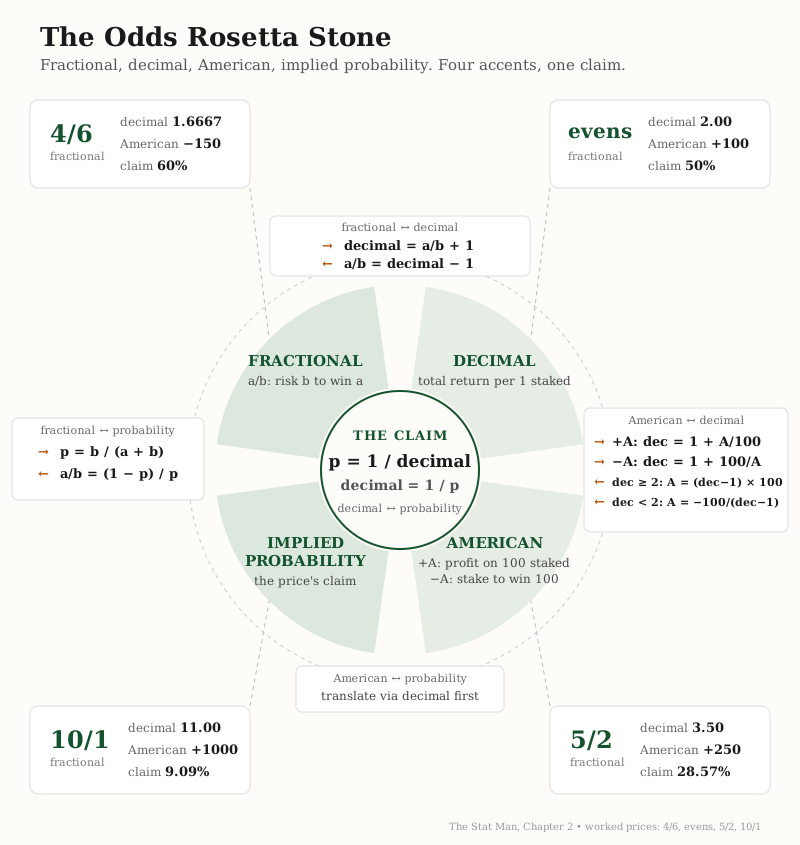
every price, in every format, is a probability claim in disguise; convert it, and you can hear exactly what the market is asserting, which is the first step towards disagreeing with it for money.
03
every football outcome has a probability between 0 and 1, the probabilities of one match's outcomes must sum to exactly 1, and the rules for adding and multiplying them are the entire toolkit.
04
a bet has value when your probability of it winning is bigger than the probability implied by the price. Nothing else about the bet matters.
05
the longer the price, the worse the value on average; longshots are systematically overbet and favourites underbet, and knowing this shrinks your losses without ever, on its own, handing you a profit.
Part 2
Chapters 6 to 11
06
the price on your app was not invented there; it is a copy of a harder market that has already absorbed the smartest money in the world, shaded and re-margined on its way to you, and it moves when the original moves.
07
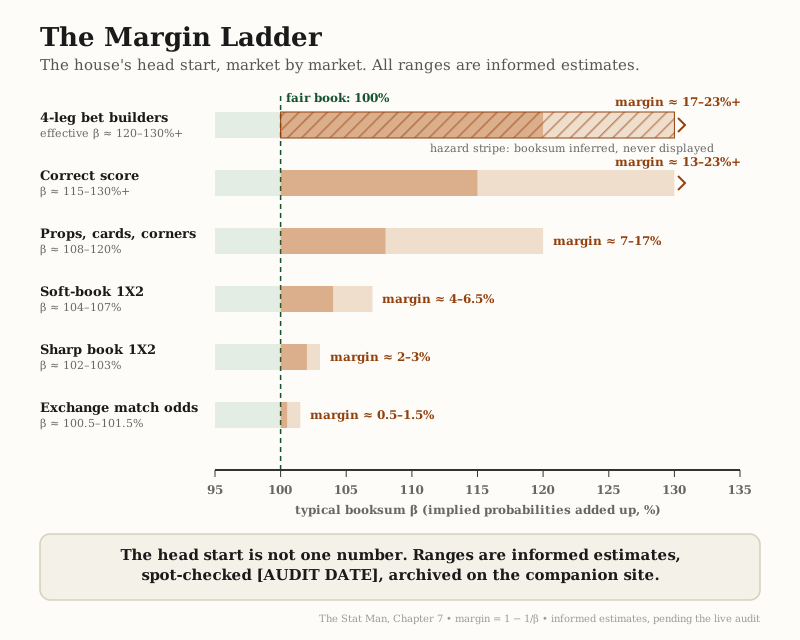
add up what a market's prices claim and you always get more than 100 per cent; the excess is the bookmaker's head start, it varies enormously by market, and you should never bet anywhere without knowing how big it is.
08
a quoted price is the market's opinion with the rent still in it; strip the margin out before you let the market's number argue with yours.
09
an exchange is not a bookmaker but a marketplace where punters bet against each other, the operator takes a commission whoever wins, and for once the house's cut is not hidden in the price; it is itemised on the receipt.
10
an accumulator multiplies everything on the slip, and everything includes the margin; the house's cut compounds leg by leg, which is why the product sold with the biggest dreams carries the biggest hidden tax.
11
the odds decide what you might be paid; the settlement rules decide what you are actually paid, and you agreed to those rules whether or not you ever read them.
Part 3
Chapters 12 to 15
12
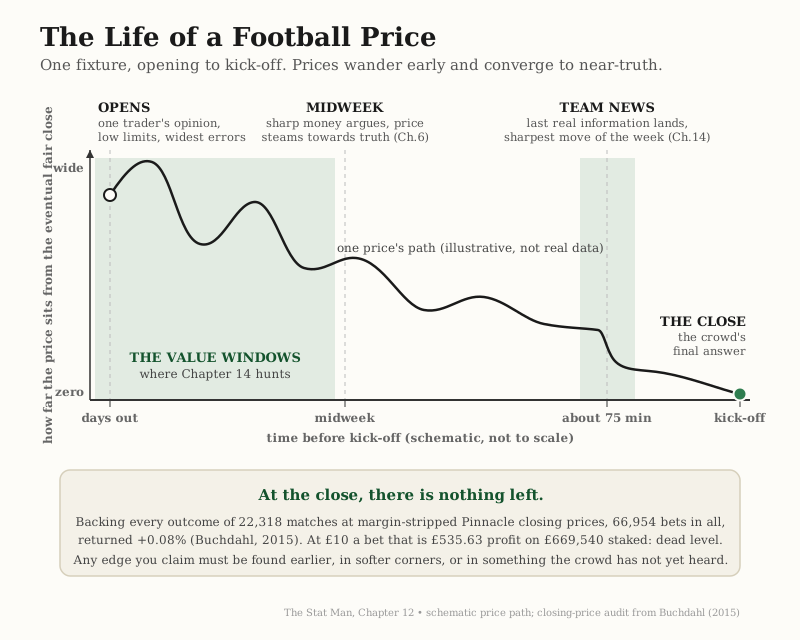
by kick-off, the market's margin-stripped closing price is on average about as good an estimate of the true probabilities as exists anywhere in public, so any edge you claim must be found earlier, in softer corners, or in something the crowd has not yet heard.
13
every claimed market bias is a testable statement about the crowd's habits, and each one deserves a dated verdict from current evidence rather than a nod from folklore; the market's surviving mistakes are where your value lives, and only the surviving ones.
14
strip the margin from the sharpest price you can find, treat what remains as the truth, bet only where a softer bookmaker beats that truth by enough, and hunt in the hours when prices are still half asleep.
15
before any bet, run the same ten checks in the same order, and let "no bet" be the answer you expect rather than the answer you dread.
Part 4
Chapters 16 to 23
16
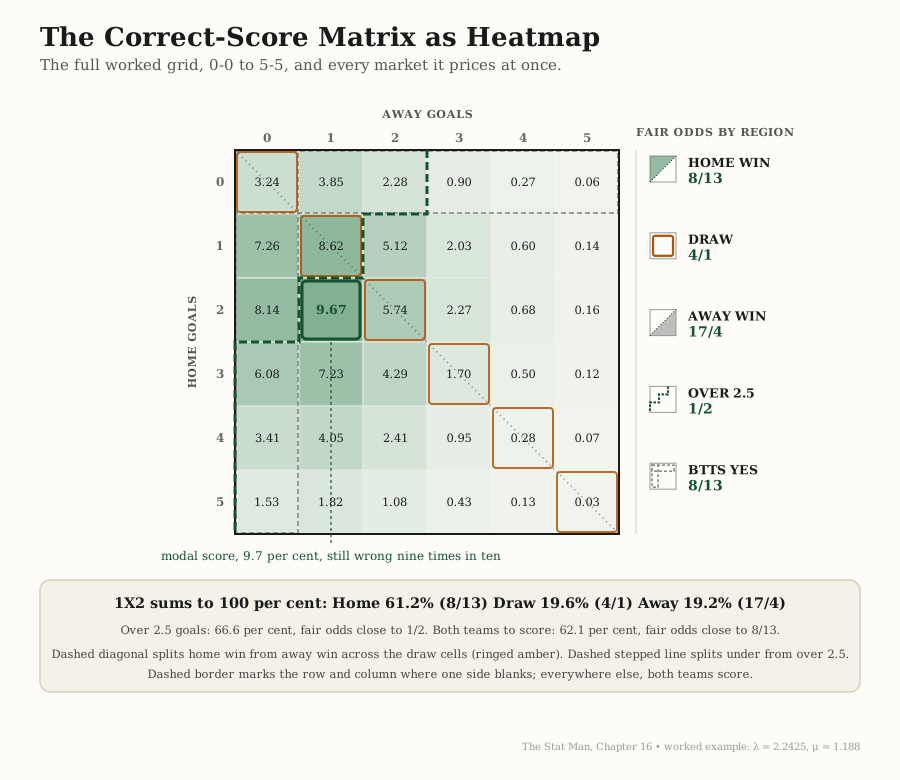
football goals behave, closely enough to matter, like rare independent events with a stable average rate, and one elegant distribution turns four numbers into a fair price for almost the entire match odds board.
17
the naive Poisson model treats every match as two independent goal-scoring processes, and it is very nearly right; Dixon and Coles found the four cells where "nearly" was costing punters money, and fixed them with one small number.
18
a good rating is not a snapshot of how strong a team is; it is a running argument between what you believed yesterday and what the scoreboard just told you, and the whole skill lies in choosing how much the scoreboard gets to win.
19
xG is not a verdict on how a match should have gone; it is a probability attached to one shot, and in this book its only job is to become the lambda and mu that price the match.
20
results regress to what the underlying performance actually deserves, and the gap between the table and the process is the punter's clearest, most repeatable source of value.
21
home advantage is real, it has been shrinking for well over a century, and for a few pandemic months it was switched off entirely, which is how we finally learned how much of it the crowd was supplying all along.
22
every number in this book that you did not collect yourself was collected, hosted and licensed by somebody else, on terms that can change on a Tuesday, so date-stamp everything and check the source's own documentation before you build anything that depends on it.
23
a backtest only tells the truth if every number inside it could genuinely have been known, in exactly that form, at the moment the bet was struck; break that rule anywhere in the chain and the return you compute is a return nobody could ever have collected.
Part 5
Chapters 24 to 27
24
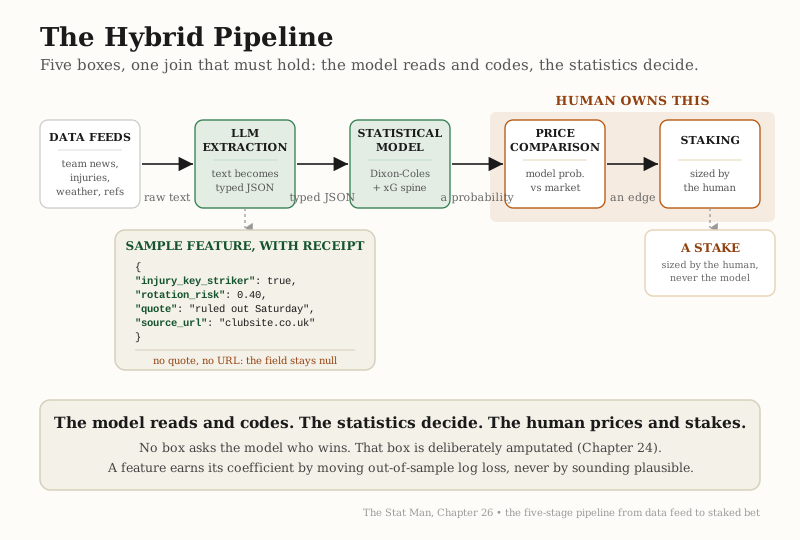
ask a language model who is going to win and you have bought a very expensive coin toss, because every credible study to date says so; ask it instead to read, extract and write code, and you have hired a tireless analyst who never dozes off through a press conference.
25
a language model is superb at turning a pile of unstructured words into a tidy structure, and useless as an oracle; use it for the first job, never the second.
26
an LLM is a very well read research assistant, not a tipster; it earns a place in your model only when what it reads becomes a number that competes for its life against real results, and every fact it hands you arrives with a receipt.
27
any system that reads the open internet for facts will eventually be fed a lie, on purpose or by accident, and the only real defence is refusing to let scraped text do anything except sit there and be checked.
Part 6
Chapters 28 to 32
28
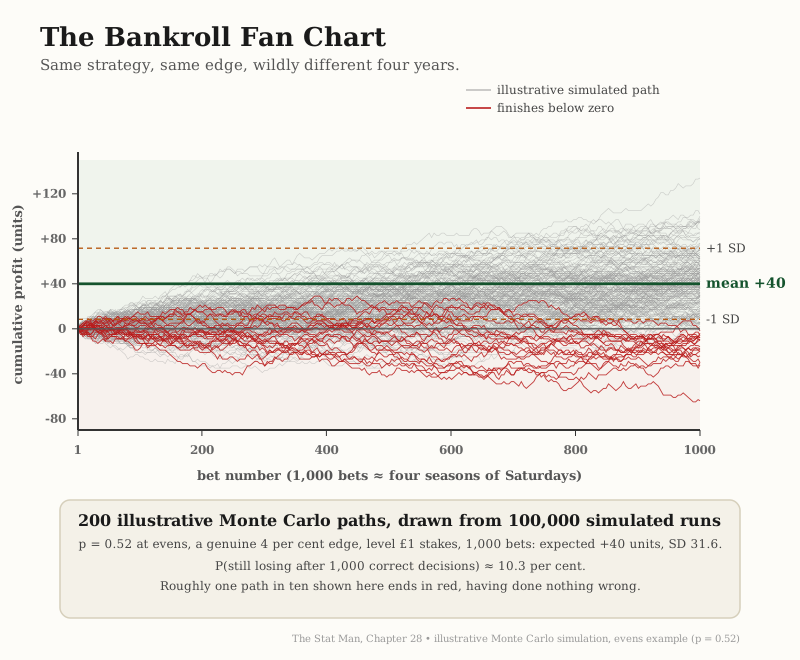
even a genuine edge produces long, ordinary-looking stretches of losing, and until you have simulated your own strategy and stared at those stretches on paper, you do not actually know what you have agreed to.
29
the formula that tells you how much to stake for maximum long-run growth is, by construction, the same formula that stops you ever going bust; profit and safety are not a trade-off here, they are the same number.
30
most betting records, including yours, are too short to prove anything at all. Closing line value is the shortcut that tells you sooner.
31
in British betting, being demonstrably good at this is, on its own, sufficient grounds to be shown the door, and the door is closed by contract rather than by law.
32
the house's margin makes the crowd's aggregate loss a mathematical outcome, not a run of bad luck, and the only thing standing between you and becoming part of that crowd's arithmetic is a set of pre-agreed limits that do not care how you feel on a Saturday.
Reference
Tables, checklists and templates
A
Reference material at the back of the book.
B
Reference material at the back of the book.
C
Reference material at the back of the book.
D
Reference material at the back of the book.
E
Reference material at the back of the book.
Chapter one is published here in full, free to read. The terms used throughout are defined in the glossary.